Abraham Lincoln and Manchester
Archive blog with ILN images of relief queues (22 November 1862) and the Manchester copy of Lincoln’s letter.
Open the sourceLondon reads the American Civil War, 1861–65
Lancashire’s mills fell idle while London’s newspapers argued about whether to side with the South. This site reads the London press and Punch against Manchester’s address to Lincoln and asks whether metropolitan opinion matched the mill towns.
Manchester is our contrast, not our setting. The London material has to carry the argument, with Manchester showing how a provincial, working-class voice sounded next to the capital’s papers.
The Union blockade began in April 1861 and sharply cut the cotton reaching Liverpool and the Lancashire mills. By winter 1862 distress was serious across the county. The Illustrated London News ran sketches of relief queues in November 1862.
Archive blog with ILN images of relief queues (22 November 1862) and the Manchester copy of Lincoln’s letter.
Open the sourceA Kent dissertation compares The Times, The Economist and The Spectator between 1860 and 1862. The Spectator’s archive is free online, including its review of W. H. Russell’s My Diary North and South on 7 June 1862. The Trent affair of late 1861, when the Union seized Confederate envoys from a British ship, brought Britain close to war.
A contemporary review in a London weekly.
Open the sourceA dissertation we can use to find articles, not as an authority.
Open the sourceShort account of the crisis.
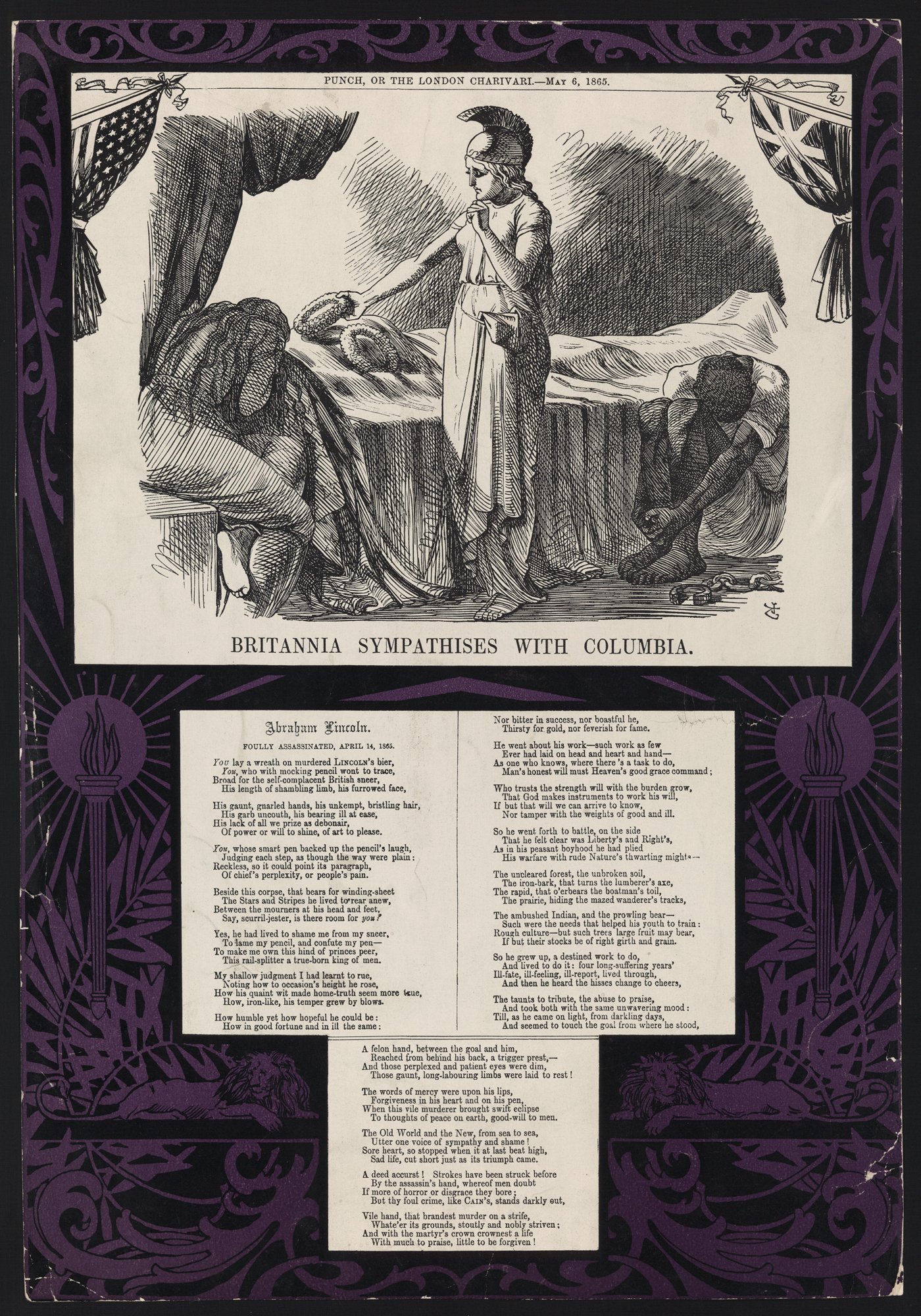
Open the sourcePunch is the obvious visual source, and it needs careful dating. The cartoon at the top of this page appeared on 6 May 1865, after Lincoln’s death. The Punch Cartoon Archive has galleries on the war, and the Library of Congress and Dickinson College hold scanned examples.
Digitised print with the verse.
Open the sourceScanned cartoons with commentary.
Open the sourceOn 31 December 1862 a meeting of working men at the Free Trade Hall in Manchester sent Lincoln an address supporting emancipation. He replied on 19 January 1863. Manchester Libraries hold a copy of the reply that Abel Heywood received on 9 February 1863, reference GB127.MISC/604. The historians disagree about how typical that meeting was, with Foner stressing working-class support for the North and Ellison finding more sympathy for the South in Lancashire.
Text of the reply.
Open the sourceThe same text with notes.
Open the sourceNewspapers still frame distant wars that cost people at home, and workers accepting hardship for a moral cause is a familiar argument about boycotts and supply chains. Manchester has a Lincoln statue by George Grey Barnard, given by Charles and Mrs Taft, which stood in Platt Fields from 1919 and has been in Lincoln Square since 1986.
Punch, “Britannia sympathises with Columbia”, 6 May 1865. Library of Congress, item scsm000474 (https://www.loc.gov/item/scsm000474/). The record gives the rights advisory: no known restrictions on use or reproduction.